AI Adoption Is a Change Management Problem
AI Adoption Is a Change Management Problem
Every conversation about AI implementation sounds the same.
"We're rolling out ChatGPT to the organisation." "We're training everyone on the new AI tools." "We're integrating AI into our workflows." And then, in quiet meetings six months later: "People just aren't using it."
The problem isn't the AI. It's not the tools or the training. It's that organisations treat AI adoption as a technology problem when it's actually a change management problem.
Here's what happens: you spend six months finding the perfect tool. Testing it. Building the business case. Getting buy-in from the executive team. Rolling it out. Providing training. Then you wait for adoption to skyrocket. Instead, adoption flatlines.
People use it for two weeks. They find it slightly confusing. They go back to how they were doing things before. The tool sits there, licensed, untouched, expensive. And the CFO starts asking why.
Why AI Tools Fail (Spoiler: It's Not the Tool)
The reason adoption fails isn't that people are Luddites or resistant to change. It's that you've designed the change process around the technology instead of around the people using it.
AI changes how people work. Not just the mechanics of it. The psychology of it. When you use AI to write an email, you're not just faster. You're also trusting a machine to represent your voice. That's psychological. When you use AI to analyse data, you're making decisions based on something you don't fully understand. That's anxiety-inducing.
Most organisations skip over this entirely. They install the tool, run a training, and assume people will overcome these psychological barriers on their own.
They won't. Because the barriers aren't in their heads. They're in the design of the adoption process.
The Adoption Curve Isn't About Resistance
There's this idea that some people are "early adopters" and some are "laggards." The theory says if you just reach the laggards, everyone will adopt. So organisations spend a fortune on training programmes and change communication trying to convince the last 20 percent to get on board.
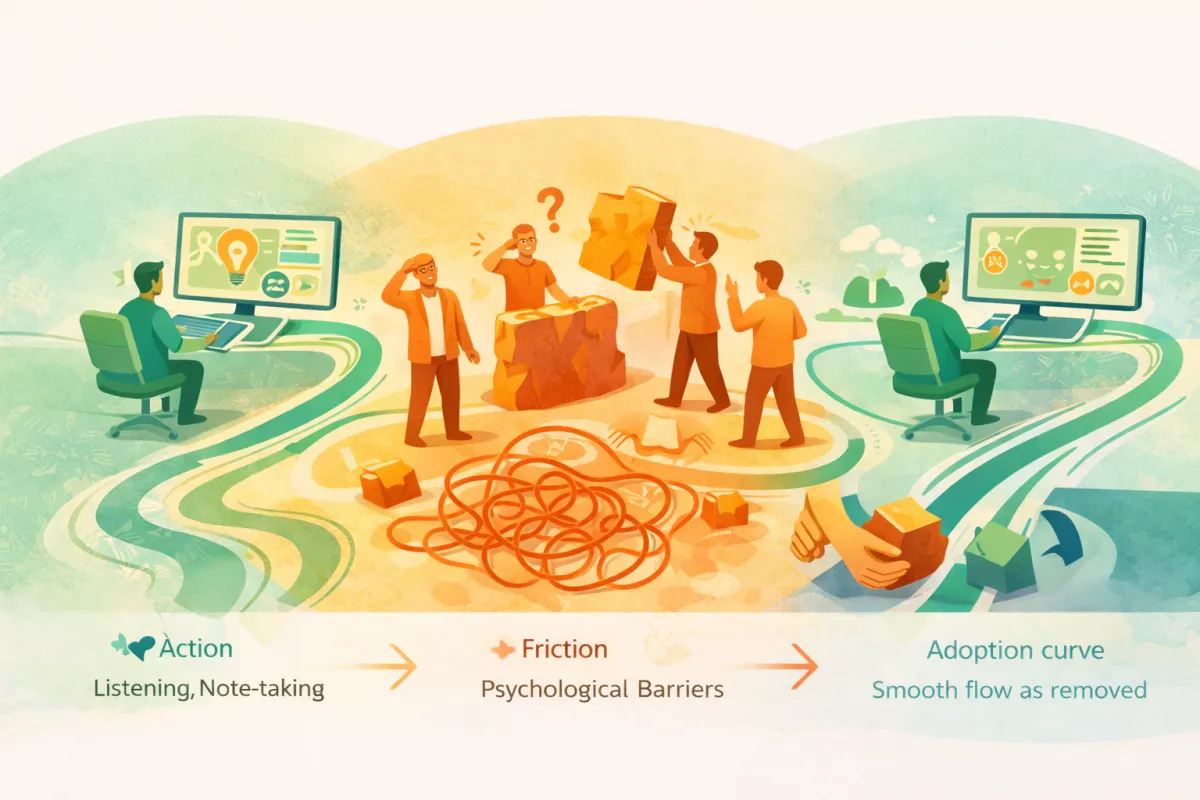
What they're actually measuring is friction. The people at the back of the adoption curve aren't being stubborn. They're rationally responding to a badly designed experience.
If the tool is confusing, they're waiting for it to improve. If it breaks their workflows, they're waiting for a workaround. If nobody around them is successfully using it, they're waiting to see who figures it out. It's not resistance. It's sensible caution.
The organisations that actually achieve AI adoption aren't the ones with the best tools. They're the ones that designed the change around how people actually work.
Three Things That Actually Drive AI Adoption
1. Reduce friction to the obvious point.
Every obstacle to using the tool is a reason to quit. Does it require logging in to a different system? Friction. Does the output need to be reformatted before you can use it? Friction. Does it require approval from someone before you can hit enter? Friction.
Find every friction point in the workflow. The most successful AI adoptions are the ones where the tool is so embedded in how you already work that using it is easier than not using it.
2. Show early wins by role, not company-wide.
"Here's how the marketing team cut their copywriting time by 40 percent" works. "Our company is using AI more efficiently" doesn't. People don't change based on company metrics. They change based on seeing someone like them succeed and going, "Oh, I could do that too."
Find one role. Marketing, or support, or finance. Pick one small win. Run it hard. Make it public. People in that role will start experimenting. They'll start finding other uses. The adoption spreads because they're seeing proof, not hearing speeches.
3. Change the incentive system, not just the tool.
If you're asking people to spend time upskilling on AI but still evaluating them on the old metrics, you've built a structural contradiction. They'll use the tool when they have spare time. Which they don't.
Find one place where the incentive system contradicts what you're asking people to do. Fix it before rollout. Maybe it's how you measure support tickets. Maybe it's how creative work is evaluated. Maybe it's how much time someone can spend on learning. Find it. Change it. That's what actually drives adoption.
One Thing to Do This Week
Pick the three biggest adoption blockers you're already hearing. "It's too complicated." "It slows me down." "I don't trust the output." Those three complaints are your design brief.
Don't respond by creating more training. Respond by redesigning the experience so those complaints go away. Can you make it simpler? Can you embed it deeper into existing workflows? Can you build in verification checks so trust builds gradually?
That's what changes adoption curves. Not convincing people. Designing better.
---
AI adoption fails when organisations design for the technology instead of for the people who have to live with it.