
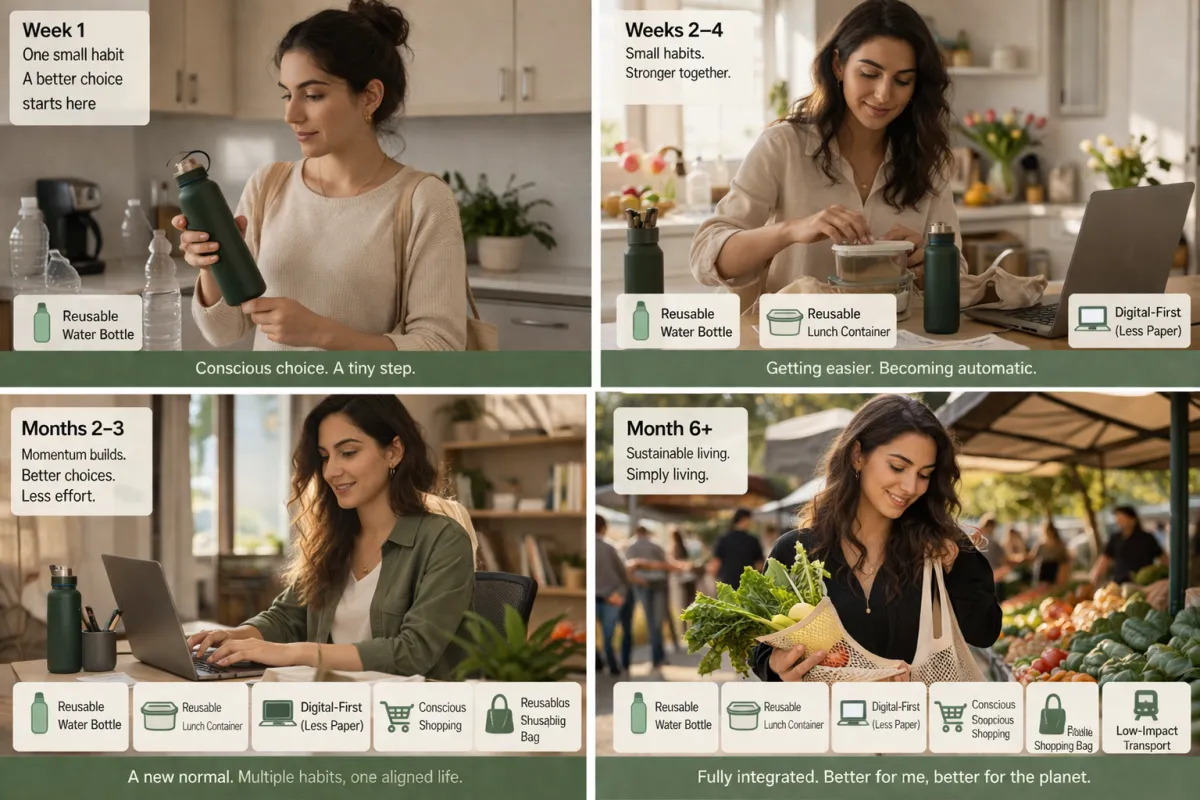
Building Habits for a Sustainable Lifestyle: Start Small, Make It Stick
The person who says they'll never use plastic again on Monday and is back to disposable cups by Wednesday knows something important. Willpower is not a strategy. Sustainable habits fail because we treat them as a test of character rather than a challenge of design.
Most sustainability advice starts with the person and assumes the behaviour will follow. Cut plastic. Reduce consumption. Go zero-waste. It's aspirational. It's also why 80% of people abandon their sustainability goals within a month. The gap isn't between what people want and what they believe. It's between the friction of change and the ease of the default.
Real behaviour change comes from making the sustainable choice the path of least resistance.
How Habits Actually Form
BJ Fogg's research on behaviour change shows that tiny habits compound. Not because people suddenly develop iron will, but because you design an environment where the new behaviour requires less effort than the old one. You stack a new behaviour onto an existing routine, reducing the cognitive load.
This matters for sustainability because environmental impact happens at scale through repeated, small choices. One plastic bag matters less than the habit of always carrying reusable bags. One car-free commute matters less than making that commute your default. The power lies in automaticity, not aspiration.
Three Steps to Build Sustainable Habits
First, identify your trigger. Don't start with a behaviour you want to change. Start with something you already do reliably every day. Make your morning coffee? That's your anchor. Pack a lunch? Your trigger. This isn't motivation. It's leverage. You're hijacking an existing neural pathway.
Second, stack the new behaviour onto the trigger. Use Fogg's formula: "After I [existing behaviour], I will [new behaviour]." After I make my coffee, I will fill my reusable water bottle. After I pack lunch, I will add reusable containers instead of grabbing plastic bags. The specificity matters. Vague intentions fail.
Third, start absurdly small. This is where most people fail. You don't commit to "be sustainable." You commit to one specific, tiny behaviour that takes less than two minutes. Habit researchers find that the first behaviour doesn't need to feel meaningful. It needs to feel automatic. Once the neural pathway is grooved, you add the next one.
You are not building a perfect sustainable life in three months. You are building a system where sustainable choices gradually require less conscious effort. That's the only way habits survive.
The Environment Works on Your Side
Here's what people miss: once a sustainable habit is automatic, the environment reinforces it. You stop thinking about bringing reusable bags. You just do. The friction disappears. Then, on the rare occasions when you forget, it feels wrong. The default has shifted.
This is the opposite of how most people approach sustainability. They white-knuckle their way through a month of trying to change everything at once, then collapse back to the old way because willpower was always the limiting factor.
Small consistency beats large intention every time.
Sustainability without friction removal is just motivation waiting to collapse.