
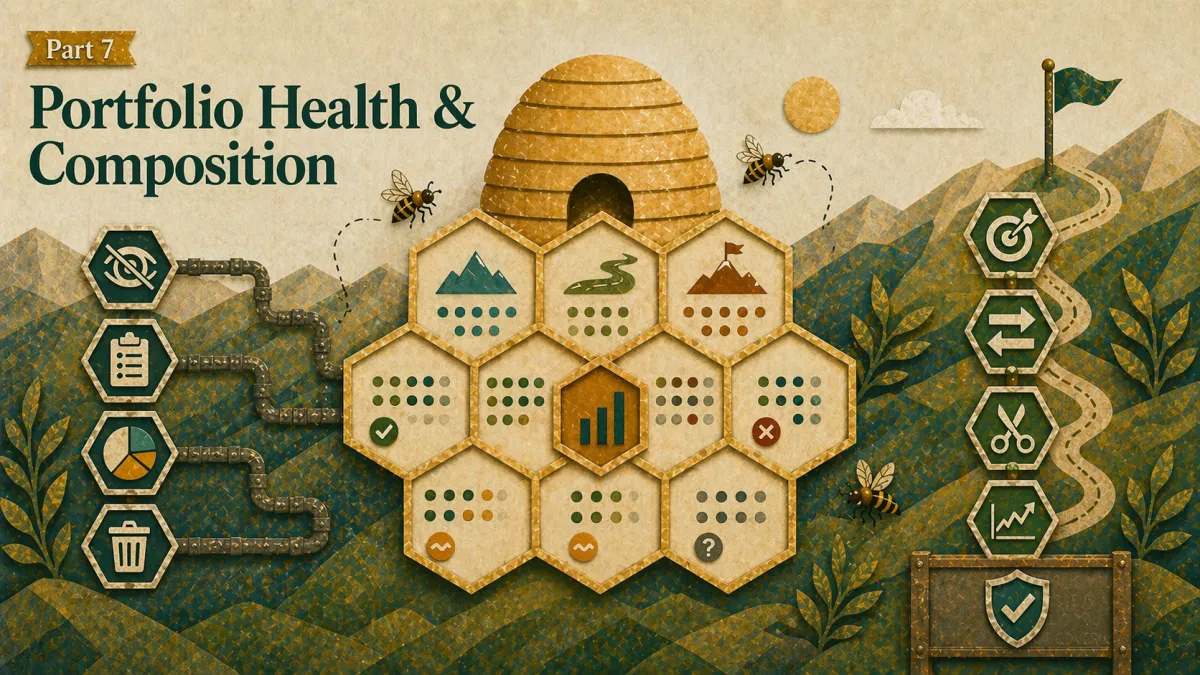
You Have 47 Innovation Projects. Can You See Them All in One View? — Embedding Innovation Series: Part 7
This is the seventh in an eight-part series on embedding innovation in large organisations, from the Honeybee Programme. People first, then process, then products, as a circle. The Hive is your organisation, the Honeycomb is where work happens, the Bees are your people, and the Scouts find tomorrow's opportunity.
Part 7 is about portfolio health and composition. This is where the system's work becomes visible as a whole.
A single project may be going well or badly. The portfolio asks a different question: given everything we are doing, is the overall shape of our investment aligned to the intent? Are we taking enough big bets? Are we starving the smaller ones? Are we killing things we should kill? No number of well-run projects saves a badly composed portfolio.
The first failure is no portfolio view at all. Each project reports individually, on its own rhythm, to its own sponsor. Nobody has a whole-system view. When leadership asks "what are we doing in innovation?" the answer is a list, not a portfolio.
The second failure is the portfolio as inventory. A list exists. It is long. It includes everything anyone has ever declared an innovation project. Nothing is ever closed. Resources are spread thin. The question "what should we stop doing?" is never asked seriously.
The third is the 70-20-10 slogan without the mechanics. Leadership has been told to split seventy percent core, twenty percent adjacent, ten percent transformational. They nod. But there is no working definition of which project is in which horizon, no review rhythm that tests the split, no decision process for rebalancing. The slogan does no work.
The fourth is killing projects based on progress against plan rather than progress against learning. A project is behind schedule, so it gets killed. But the schedule assumed hypotheses that turned out wrong, and the team has been productively learning. Killing it loses the learning. Meanwhile, a project that is on schedule and producing nothing useful continues because it is green in the review.
And the triage that never happens. Projects are started with fanfare and closed only when forced. A healthy innovation system kills projects routinely, gracefully, and without stigma. The clearest signal of a mature system is how often and how well it stops things.
What to do this week
First, ask whether you can see everything your organisation is working on in innovation in one view. If the answer is no, build one this month.
Second, count how many projects you stopped cleanly in the last four quarters. If the number is very low, your portfolio is carrying dead weight.
Third, look at whether your portfolio review is actually a portfolio review, or just a series of individual project updates. The question that matters is about the whole: are we working on the right mix?
A portfolio you cannot see is a portfolio you cannot govern. And one you cannot govern will govern you.
Next in the series: Part 8, on why the ecosystem you actually have is the one that shows up when you need it, and why your richest innovation ecosystem might be sitting inside your own building.
You can find out more here: Corporate trainings in Behaviour design
Or why not book a call and we can answer any questions: Book a call