
Circular Economy Myths and Reality: What Actually Works
Circular Economy Myths and Reality: What Actually Works
Let's be honest: the circular economy has become a bit of a buzzword. You hear it everywhere, from corporate sustainability reports to TED talks, and yet somehow the average person still struggles to understand what it actually means. Is it just about recycling more? Is it a genuine solution to our waste crisis, or another well-intentioned idea that sounds better than it performs?
The truth is, the circular economy is both more nuanced and more achievable than the hype suggests. But it's also facing some serious misconceptions that undermine its real potential.
The Myth: Recycling Will Save Us
Here's what most people believe: if consumers just sort their waste properly, the circular economy will naturally happen. We'll recycle more, manufacturers will use recycled materials, and the problem is solved. It's a comforting narrative. It puts responsibility in consumers' hands. And it's fundamentally disconnected from how the circular economy actually works.
The reality? Consumer recycling is broken. Not because people don't care. They do. It's broken because the system is designed to fail.
When you put a plastic bottle in your recycling bin, you feel like you've done your part. But that bottle is entering a system where contamination rates are staggeringly high. A pizza box with grease ruins an entire batch of recycled paper. A plastic bag wraps around sorting machinery and shuts down operations. Mixed materials arrive at facilities with no clear path to recovery. By the time your bottle reaches a sorting facility, it's competing with thousands of contaminated items for a spot in a market that's volatile and economically unpredictable.
The result? Your recycled bottle often doesn't become a new bottle. It gets downgraded to lower-value uses, sits in storage waiting for a buyer that may never come, or ends up exported to countries where it becomes someone else's waste crisis. Sometimes it ends up in a landfill anyway. And the consumer never knows, so they keep recycling, feeling virtuous, while the system quietly fails behind the scenes.
The circular economy myth positions recycling as the solution. The circular economy reality requires us to stop relying on consumer sorting altogether.
The Myth: Consumer Choice Will Drive Adoption
If we make circular products available and make people aware of them, adoption will follow. Right? That's the logic behind most corporate circular economy initiatives. We launch a take-back programme. We design products for reuse. We market them with sustainability credentials. We expect people to choose them.
But consumer behaviour doesn't work that way.
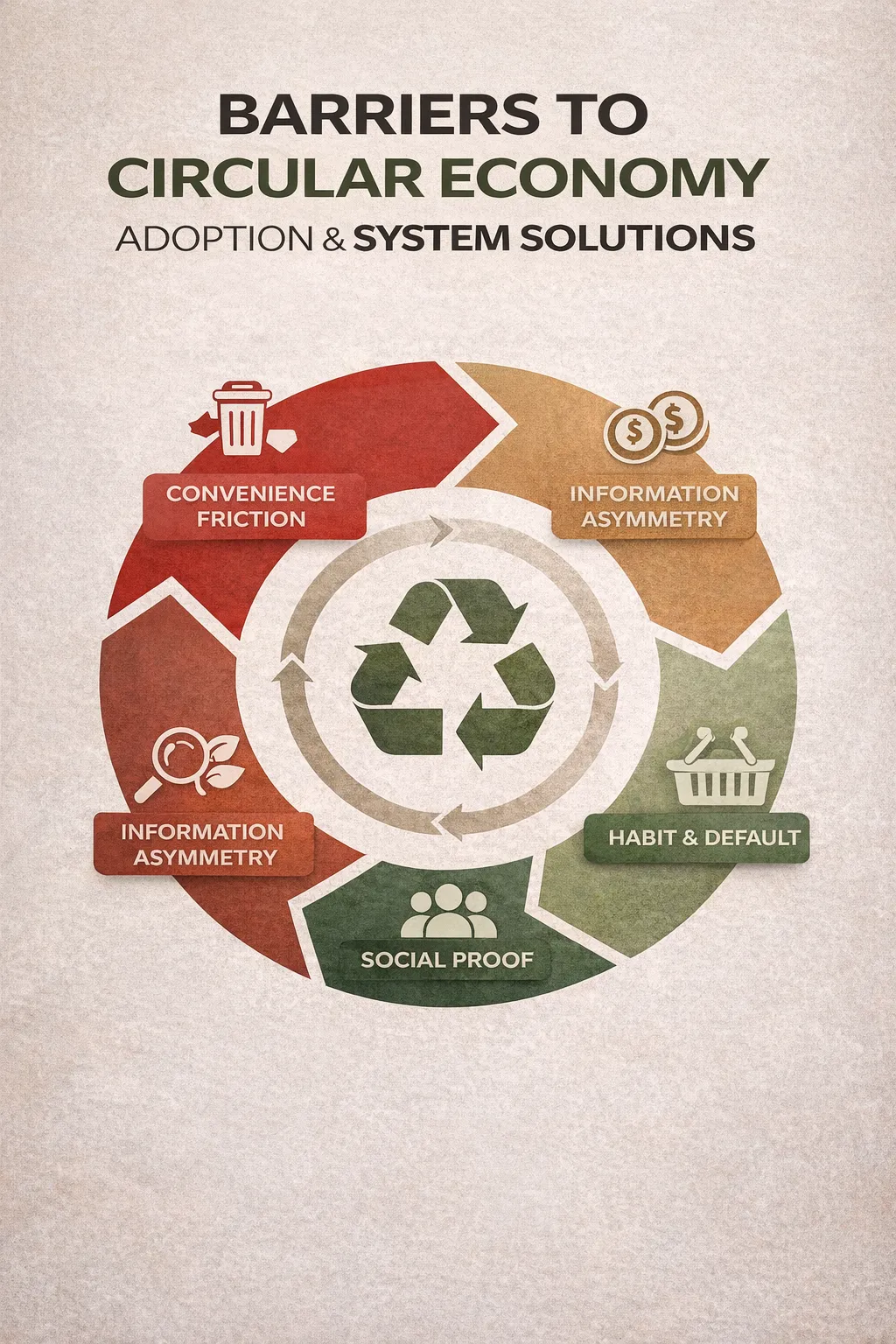
When people are making purchasing decisions, they're optimising for convenience, price, and habit, not for abstract environmental values. Circular products almost always cost more (because recovery infrastructure is expensive and hasn't reached scale). They require more effort to use (returning products, following care instructions, tracking reuse). And they swim against the current of established habits and defaults.
A study on furniture rental found that even when people expressed strong stated preferences for circular consumption, they still bought new furniture when the moment came. Why? Because the circular option required more planning, offered less selection, and didn't feel like "ownership." The gap between what people say they value and what they actually choose is enormous. It's not a gap you close with better marketing.
The circular economy myth positions choice as the mechanism. The circular economy reality requires removing choice by changing what's available and easy.
The Myth: If We Design Better Products, People Will Keep Them Longer
This one is intuitive: design products to last longer, make them easier to repair, and people will repair them instead of replacing them. Durability equals circularity, right?
Wrong.
Consumer behaviour research shows that people rarely repair products. They replace them. This is true across income levels and demographics. The reasons are behavioural, not rational: replacing feels simpler than repairing, repair information is hard to find, replacement is often faster, and keeping a broken product around creates cognitive load. Even when repair is cheaper, people choose replacement.
The circular economy doesn't work through durability. It works through disassembly. Instead of designing products to last forever (which consumers won't repair anyway), design them to come apart cleanly at end-of-life so materials can be recovered systematically. Instead of hoping consumers will maintain and repair, build recovery into the business model so the producer manages the process.