
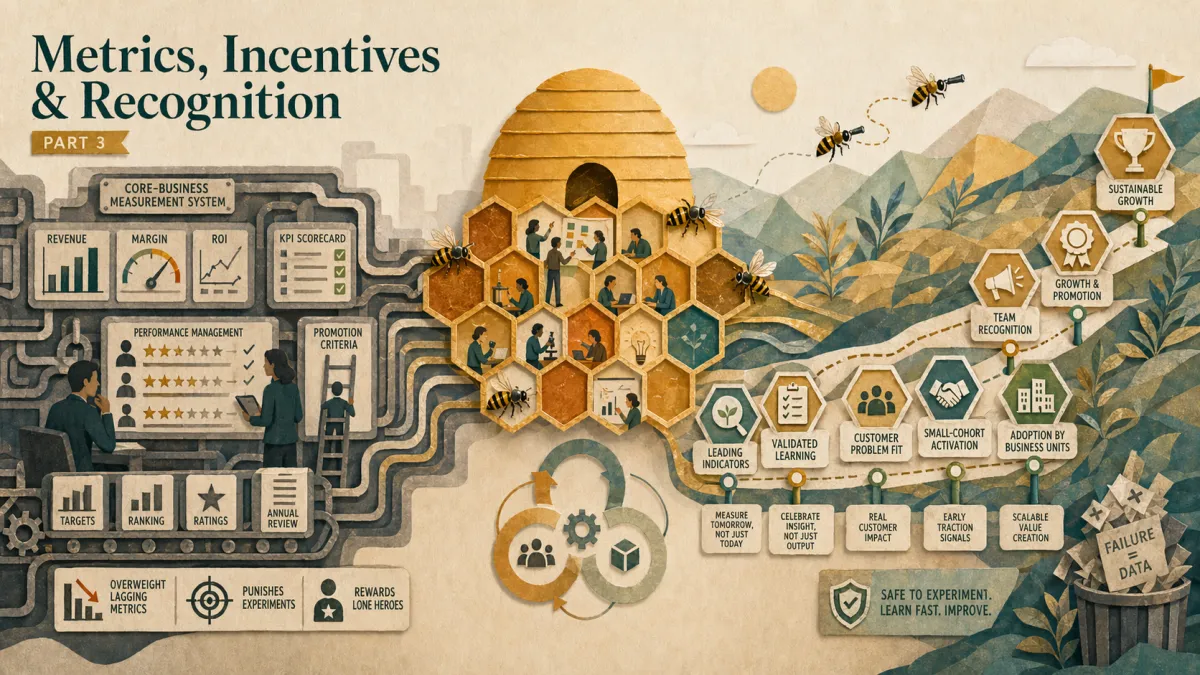
Your People Know Exactly What Gets Them Promoted. Does Innovation Feature? — Embedding Innovation Series: Part 3
This is the third in an eight-part series on embedding innovation inside large organisations, drawn from the Honeybee Programme. The operating philosophy: people first, then process, then products, as a circle. The metaphor: the Hive is your organisation, the Honeycomb is where work happens, the Bees are your people, and the Scouts find tomorrow's opportunity.
Part 3 is about metrics, incentives and recognition. Structure (Part 2) says where innovation work lives. This pillar says what the people doing it are actually rewarded for.
Here is the diagnostic question that matters more than any dashboard: if you asked a high-performing middle manager in your organisation what they need to do to get promoted, how much of their answer would involve innovation work?
In most organisations, the honest answer is none. And that tells you everything about whether innovation will actually happen, regardless of how many frameworks you introduce.
Metrics are what the organisation measures. Incentives are what it pays for. Recognition is what it celebrates publicly. These three do not have to be the same thing, and in poorly set-up organisations they contradict each other. If innovation is measured but not paid for, it becomes a compliance exercise. If it is paid for but not celebrated, it becomes a side hustle nobody talks about. If it is celebrated but not measured, it becomes theatre.
The dominant failure is measuring innovation by the metrics of the core business. Revenue, margin, and cost-to-serve are right for the core. For early-stage innovation, they produce false negatives (killing promising work that does not yet make money) or false positives (rewarding superficial wins that juice the numbers without creating value). Innovation needs leading indicators first: validated hypotheses, learning per dollar, customer-problem-fit, activation of small cohorts. The trailing indicators come later.
Then there is the punishment nobody admits to. No senior leader describes it as punishment. But it manifests as quiet exclusion from the next promotion round, assignment to a less visible role, the feeling that you are now less trusted. In organisations where failure on an innovation project costs a career, rational people stop volunteering for innovation work.
The interface mismatch is equally destructive. The innovation team is rewarded for launching new products. The business unit that would adopt and scale the product is rewarded for meeting this year's number. Adopting the new product introduces risk. The rational business unit declines. The innovation team hits its metric. Nothing actually changes.
And then there is hero culture. The CEO praises the individual who "broke through the bureaucracy." Left unspoken: the bureaucracy is the system the CEO runs. Good recognition does not celebrate the hero. It celebrates the system that allowed the individual to succeed.
What to do this week
First, ask what your innovation practitioners are actually measured on. If the answer includes trailing indicators like revenue for early-stage work, fix that first.
Second, find the last project that was killed and ask where the people on it went. If they were quietly sidelined, your organisation is punishing failure whether it admits it or not.
Third, check the incentives on your business unit leaders. Are they rewarded for adopting new capabilities from the innovation function, or protected from the need to?
The organisation will do whatever you actually reward. Stating your priorities does not change this.
Next in the series: Part 4, on why training hundreds of people on design thinking changes nothing if nobody coaches them on live work.
You can find out more here: Corporate trainings in Behaviour design
Or why not book a call and we can answer any questions: Book a call