
Your Culture Eats Your Innovation Programme for Breakfast, Lunch, and Dinner — Embedding Innovation Series: Part 6
This is the sixth in an eight-part series on embedding innovation in large organisations, from the Honeybee Programme. People first, then process, then products, as a circle. The Hive is your organisation, the Honeycomb is where work happens, the Bees are your people, and the Scouts find tomorrow's opportunity.
Part 6 is about culture, trust and learning dynamics. This is the pillar that determines whether everything else you have put in place is actually used.
Culture, in the sense that matters here, is the set of observable behaviours that tell a person what is safe, what is rewarded, and what is punished. Trust is the degree to which people believe that what they say, try, and fail at will be handled fairly. Learning dynamics are the rhythms by which the organisation turns experience into improvement, or fails to.
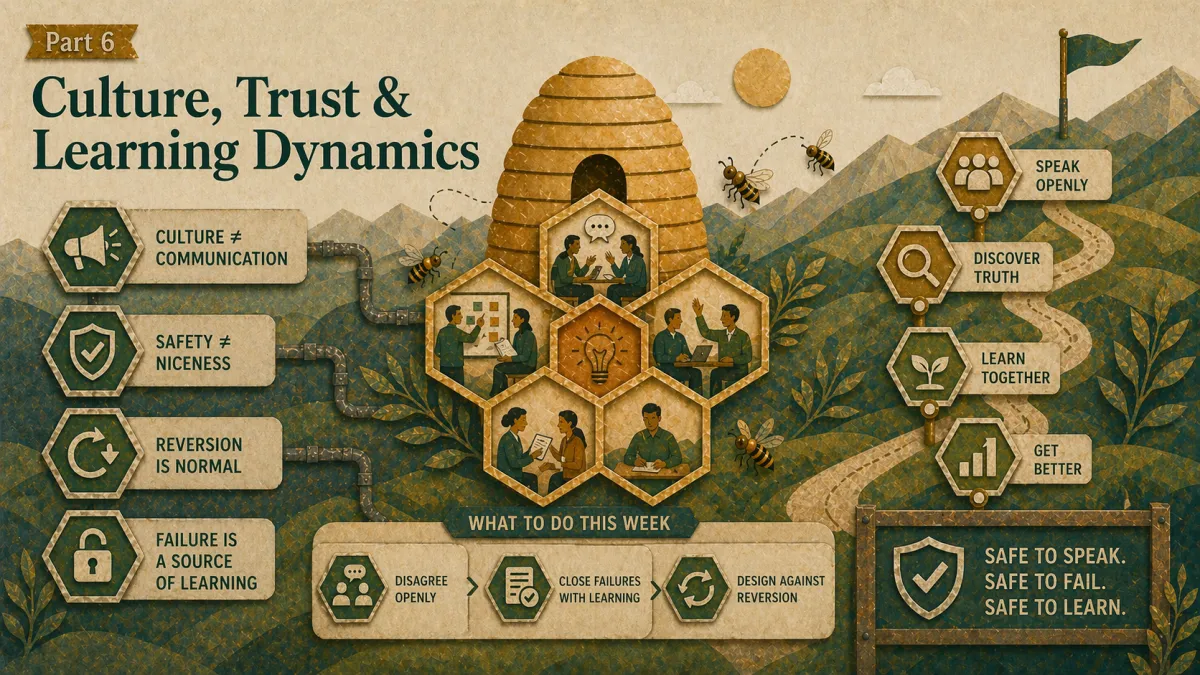
The internal name for this pillar in our diagnostic is psychological safety and reversion dynamics. Without psychological safety, people do not speak honestly. Without honest speech, the organisation cannot see what it is actually doing. And without deliberate attention to reversion, the tendency of humans under stress to fall back into old behaviours, any change you introduce will quietly undo itself within twelve months.
The dominant failure is treating culture as a communications exercise. Values are published. Posters go up. Town halls are held. The stated culture is warm. The enacted culture, the one a new hire experiences in their first month, is cold, political, or punitive. The gap between stated and enacted culture is the most consequential cultural datum in any organisation, and the one most organisations never measure.
The second failure is psychological safety misunderstood as niceness. Psychological safety does not mean comfort. It means people feel safe to raise problems, disagree, admit mistakes, and propose new ideas. A culture that is nice but avoids hard truths has low psychological safety. A culture where people argue vigorously and admit errors openly is high in psychological safety, even if it feels spiky.
Reversion is the silent killer. Change is introduced. Teams are trained. New practices are adopted. Six months in, the programme is declared a success and external support steps back. Twelve months in, the new practices have quietly become the old practices with a new label. This pattern is so reliable it should be the default assumption for any change effort that does not deliberately design against it.
And then there is the failed project as a source of shame rather than learning. The project is quietly wound down. Nobody speaks of it. The people are dispersed. The lessons are lost. The pattern that produced the failure is now more likely to recur because it has become invisible.
What to do this week
First, recall the last time a junior person visibly disagreed with a senior person in a meeting and it went well. If you cannot recall, your enacted psychological safety is low regardless of what your engagement survey says.
Second, ask how failed projects are handled. Are they closed cleanly with learning captured and people redeployed to good roles? Or quietly disappeared?
Third, if you introduced a new way of working today and stepped back in twelve months, how confident are you it would still be in use? If your confidence rests on hope rather than specific reinforcement mechanisms, you have not designed against reversion.
If you do not design against reversion from day one, reversion will be your outcome.
Next in the series: Part 7, on why the most important artefact for governing innovation is the one most organisations either do not have, do not trust, or do not use.
You can find out more here: Corporate trainings in Behaviour design
Or why not book a call and we can answer any questions: Book a call