
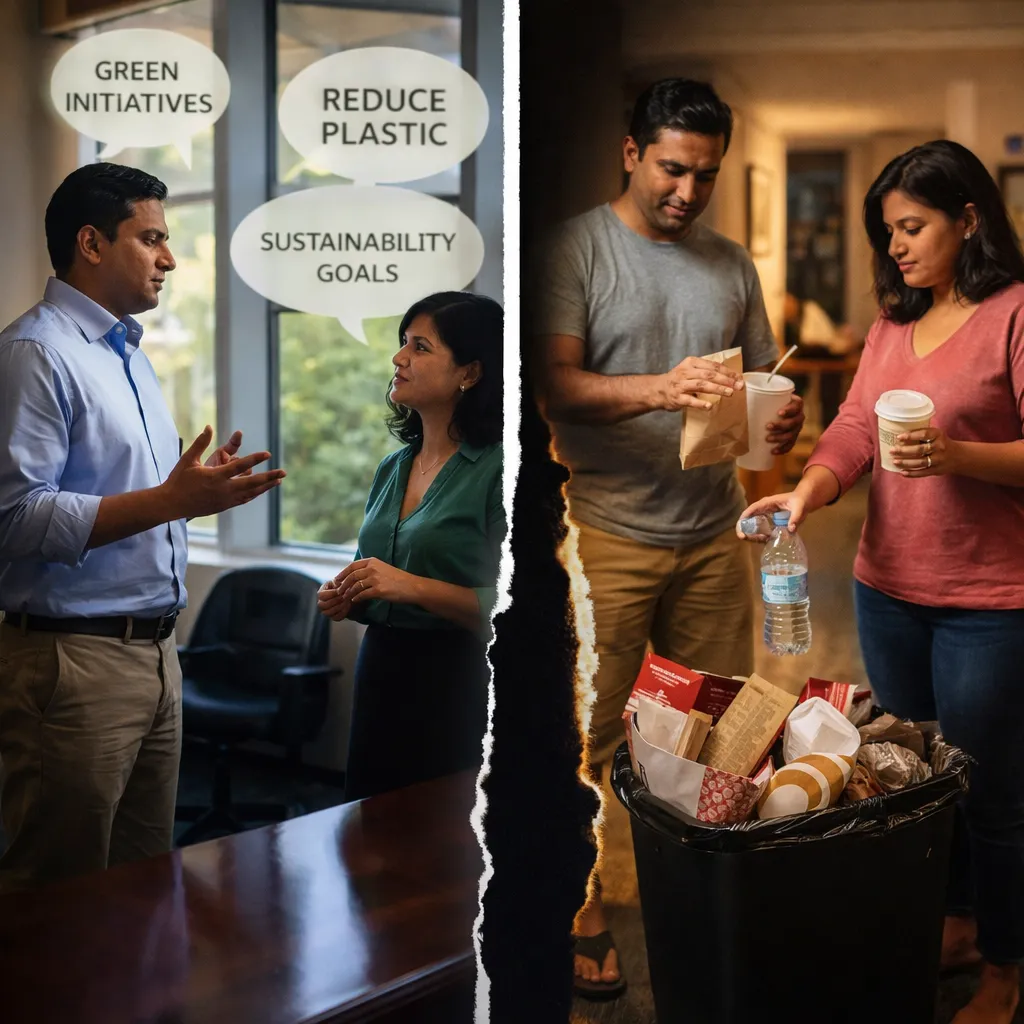
Sustainability and the Say-Do Gap: Where ESG Fails Internally
Your company released its net zero commitment last year. You have published the targets. You have hired the sustainability officer. You have attended the workshops. And the behaviour of your organisation has barely changed. People are still printing double-sided documents. Meetings still happen with people in the same room and three others on Zoom. Your supply chain practices have not shifted. Your team still flies instead of taking the train.
This is not a lack of commitment. This is the say-do gap applied to sustainability. Everyone agrees sustainability matters. Nobody has designed the friction out of the new behaviours. So people default to what is easy, not what is right.
Sustainability is a behaviour change problem masquerading as an environmental problem. You cannot policy your way through it.
The Three Barriers That Stop Internal Adoption
First is friction. The sustainable choice is harder. Taking the train takes longer than flying. Printing is simpler than digital collaboration. Meeting in person is easier than designing a hybrid space that works for everyone. You have not removed the friction. You have just added guilt. Guilt does not change behaviour at scale.
Second is salience. Your team does not think about their impact because nobody has made it visible. Your carbon footprint per flight. Your paper usage. Your energy consumption per person. You know the number for shareholders. You do not know the number for the team. When the impact is invisible, it is easy to ignore.
Third is identity. Sustainability is framed as sacrifice. You have to give things up to be responsible. But your identity is still built around convenience and efficiency. You have not made sustainability part of how you see yourself or your role. So when convenience and sustainability conflict, convenience wins.
Step 1: Make the New Behaviour Easier Than the Old One
Not equally easy. Easier. How does your team book travel. Can they see the carbon impact next to the price. Can they book a train ticket in the same system as a flight. Does the system default to the lowest carbon option instead of the fastest. This is not messaging. This is design.
How do people collaborate. Are video meeting rooms easier to book and use than physical conference rooms. Is there a one-click option to schedule a hybrid meeting properly instead of just turning on the camera. Design friction into the old behaviour and out of the new one.
Step 2: Measure and Share the Impact Transparently
Tell your team what is happening. In their team. This month. We saved 40 tonnes of CO2 because you moved 15 flights to trains. We saved 2 million litres of water because we fixed the cooling system. We avoided 50 tonnes of waste because we changed how we handle packaging.
Make it personal. Make it real. Make it visible in tools they use daily. Not in a quarterly sustainability report. In Slack. On the dashboard. Where they work. When they see their behaviour having immediate impact, it reinforces the choice they made.
Step 3: Make Sustainability Part of How You Lead
Your executive team does not lead by pronouncing values. You lead by what you do visibly and repeatedly. Fly less. Take the train for journeys under four hours. Run hybrid meetings properly. Use a reusable cup. Do this not because you are a hero. Do it because this is how we work now. You are setting the norm by living it.
The teams that follow your lead are not responding to policy. They are responding to seeing someone they respect making the choice consistently.
Why Sustainability Campaigns Fail
Because they ask people to care without making it easy to act. Campaigns are one-way. They tell you what to do and why it matters. But if the action is friction-filled and invisible, it does not stick. Behaviour change requires design. Friction reduction. Visible feedback. Identity alignment. All the things you do not get from a campaign.
Sustainability that works internally is not communicated. It is engineered. It is built into how work happens, not announced as an initiative.
Sustainability succeeds when the right choice becomes the easy choice.