
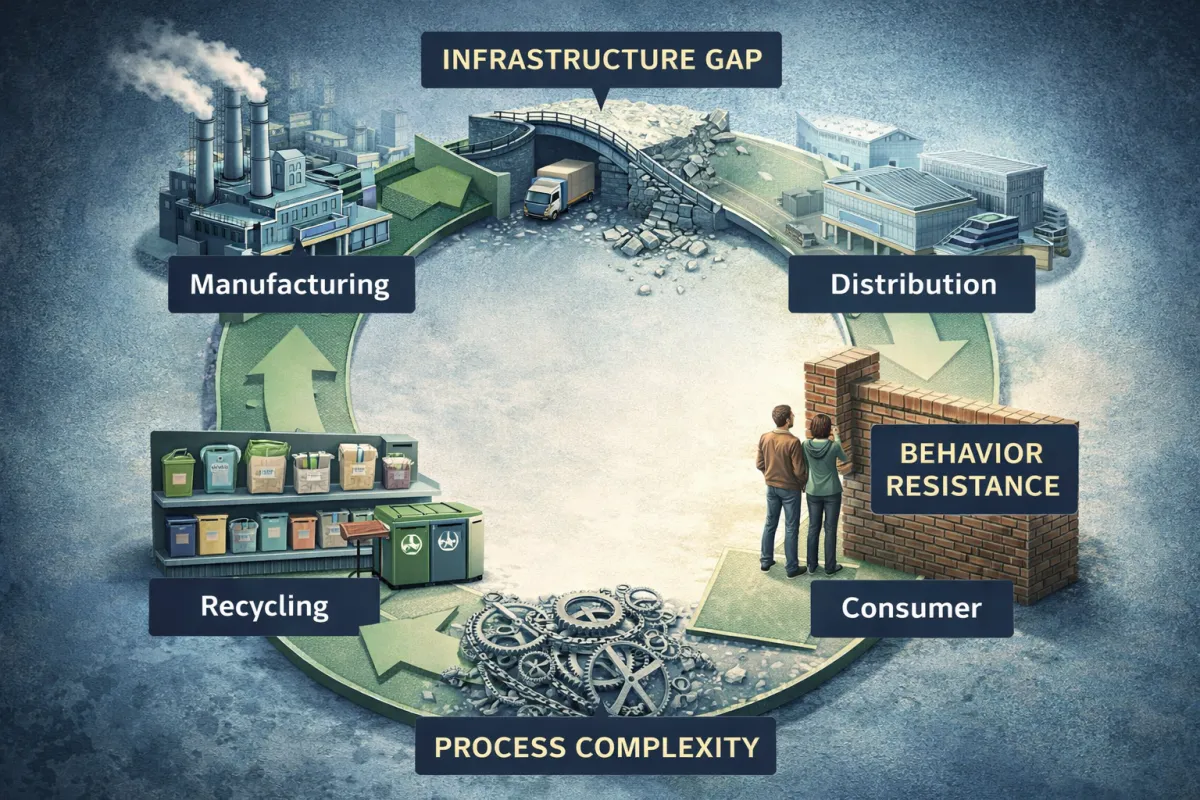
Three behavioural barriers stopping your supply chain from going circular
Every sustainability leader I meet wants to close the loop on their supply chain. Zero waste. Circular materials. Regenerative systems. It's the right ambition. It's also the hardest part of a net-zero strategy because it's not actually a supply chain problem. It's a behavioural one.
I worked with a luxury goods company with all the right pieces in place. New supplier contracts. Reverse logistics infrastructure. A beautiful circular economy roadmap. Two years in, they'd recovered less than 8% of materials they expected. The infrastructure worked fine. The problem was the people making decisions at every stage didn't actually believe it would stick around long enough to matter.
That's the first barrier right there.
The Barrier of Organisational Impermanence
Circularity requires your people to invest effort in something that doesn't show a return this quarter. It probably won't show a return this year. Your procurement team doesn't believe you'll fund the reverse supply chain for 18 months. Your logistics managers don't believe the return-for-refurbishment scheme will actually launch. Your sales team doesn't believe customers will actually participate.
So they don't build the systems that make it work.
You can announce a circular strategy. You can design it beautifully. But if people don't believe it's actually happening, they'll revert to optimising for what they know works right now. And what works right now is the linear model they've spent their entire career perfecting.
The Barrier of Competing Incentives
Here's where it gets messy. Most organisations have incentive structures designed for growth and speed. Volume. Cost reduction. Fast inventory turns. These metrics conflict with circularity at almost every point.
Your operations team is measured on cost per unit. Circular supply chains have higher unit costs (at first). Your sales team is incentivised on revenue. Circular products sometimes carry price premiums that hurt volume. Your warehouse staff are evaluated on throughput. Sorting, cleaning, and preparing returns for reuse takes time. Everybody's doing their job exactly as they're supposed to. And the system punishes the person who tries to prioritise circularity over their core metric.
This isn't cynicism. It's just how incentives work. And until you redesign them, circularity stays on the PowerPoint slide.
The Barrier of Uncertainty and Status Loss
This one is brutal because it's psychological. Circular supply chains work differently. They're less standardised. They require problem-solving that the old system didn't demand. Your experienced logistics manager suddenly becomes a novice in a new domain.
Most leaders want to look competent. When you ask them to shift to circular systems, they're being asked to become beginners again. The upgrade from linear to circular isn't just a process change. It's an identity threat. You're asking someone who spent 20 years becoming an expert in linear supply chains to accept lower status and higher uncertainty while learning something entirely new.
So they do what makes sense: they find reasons why it won't work, or why it's not their department's priority, or why the timing is wrong.
How to Break Through
You can't design your way out of these three barriers with a better infrastructure diagram. You need behavioural change.
For impermanence, commit to public targets with real consequences. Not vague goals. Specific numbers. Specific timelines. Report progress every quarter. Let your teams believe you're genuinely committed because you've given them the evidence that you are.
For competing incentives, redesign the metrics your teams actually care about. Don't add circularity as another goal. Integrate it into how you measure success. If operations are measured on cost, measure the total cost of the circular system (including recovered materials revenue). If sales are measured on revenue, measure revenue per kilogram of material circulated.
For uncertainty and status loss, invest in training that genuinely makes people expert in the new system. Not a two-day workshop. Real learning. And bring them on the journey before you ask them to change their behaviour. People care more about being heard than about being right.
Circularity isn't a technology problem or an infrastructure problem anymore. It's a human problem. And that's actually good news, because human problems have human solutions. They're just harder to build than supply chain diagrams.