
You Trained 200 People on Design Thinking. Nothing Changed. Here Is Why. — Embedding Innovation Series: Part 4
This is the fourth in an eight-part series on embedding innovation inside large organisations, from the Honeybee Programme. People first, then process, then products, as a circle. The Hive is your organisation, the Honeycomb is where work happens, the Bees are your people, and the Scouts find tomorrow's opportunity.
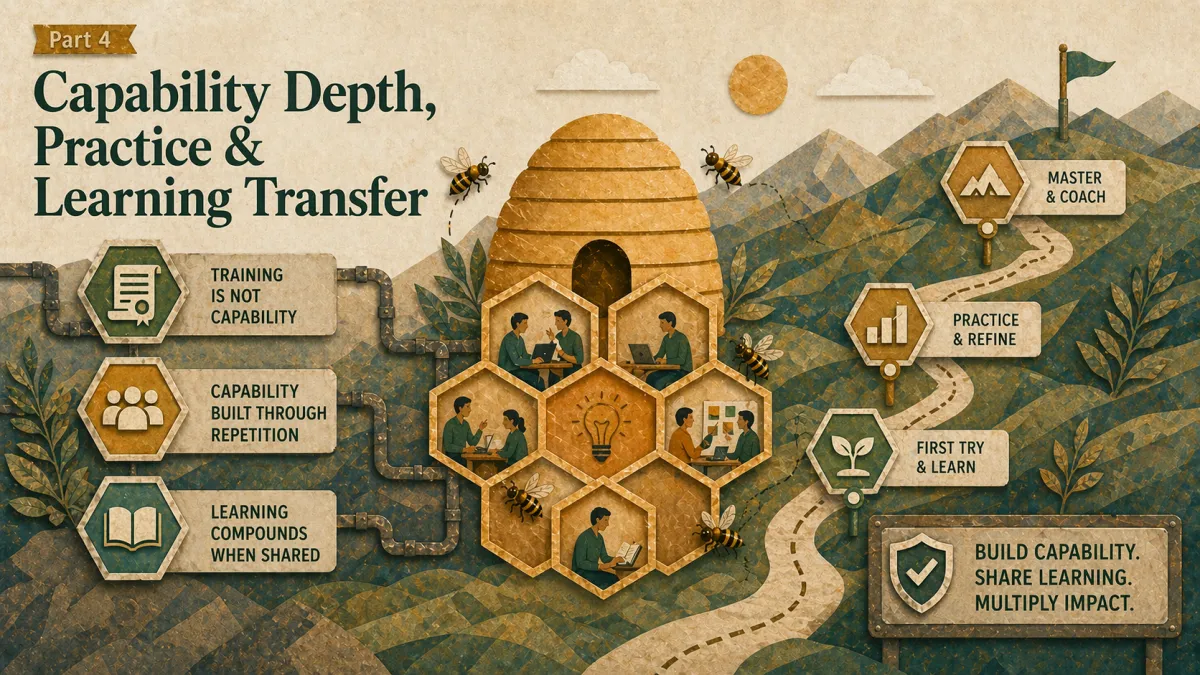
Part 4 is about capability depth, practice and learning transfer. Having established what the organisation is trying to do, where the work lives, and what people are rewarded for, this pillar asks a blunt question: can the people actually do it?
The error most organisations make is treating training attended as capability built. A large programme is commissioned. Hundreds attend workshops. They emerge able to talk about design thinking, lean startup, and agile. Six months later, ask them to run a genuine customer discovery cycle on a live project and most cannot. Knowledge transferred. Capability did not.
Capability is built only when someone does the work, several times, with feedback, under conditions close enough to real that the learning sticks. A certificate does not make a practitioner. A certificate plus two coached live projects often does. The maths is stark: if you want a practitioner to become genuinely fluent in a method, they need to do it three to five times with coaching before they can do it independently, and two or three more times before they can coach someone else. No organisation that only trains will get through those reps.
The second failure is capability concentrated in a central team. A small group of excellent practitioners sits at the centre. They are in demand. They are pulled across projects. When the team is busy, work stalls. When someone leaves, capability is lost. You have created a bottleneck disguised as a centre of excellence.
The third, and arguably most damaging, is capability neglected at the management layer. Senior leadership understands the vision. Frontline teams get the training. Middle managers, the layer that actually has to sponsor, protect, resource, and unblock the work, receive neither. This is where innovation goes to die. If your middle managers do not have the specific capability to sponsor new-to-the-firm work inside their units, nothing you do at the top or the bottom will land.
And then there is the learning that never compounds. Each project team learns its own lessons, keeps them, and the organisation loses the return. No playbook being written. No forum where teams share what failed. No library of experiments. The organisation pays the full cost of learning on every project and never reaps what it has already paid to learn.
What to do this week
First, count how many of your innovation practitioners have run three or more live projects with coached feedback. That number is your real capability depth. Not the number who attended training.
Second, look at your middle managers. Have they been deliberately equipped to sponsor and protect innovation work? Not trained on innovation methods. Trained on how to sponsor the people doing the methods.
Third, ask whether you have a playbook that is specific to your organisation, actually used by practitioners, and updated in the last six months. If not, you are losing the compound return on everything your teams learn.
Knowledge transfers fast. Capability transfers slowly, through reps, and only if you design for it from day one.
Next in the series: Part 5, on why you cannot innovate your way to a product customers love if nobody in the building has spoken to one.
You can find out more here: Corporate trainings in Behaviour design
Or why not book a call and we can answer any questions: Book a call