
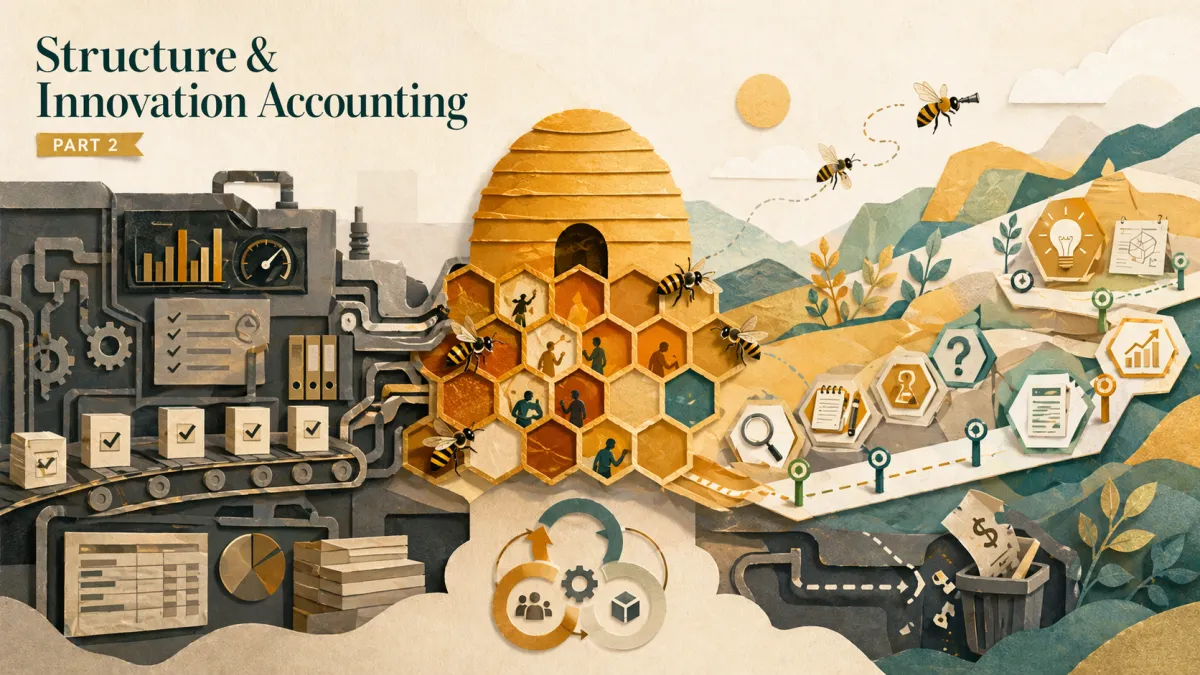
Your Innovation Budget Is Being Judged by Rules Designed to Kill It — Embedding Innovation Series: Part 2
This is the second in an eight-part series on embedding and scaling innovation inside large organisations. Each post covers one of eight pillars from the Honeybee Programme. The operating philosophy: people first, then process, then products, as a circle. The metaphor: the Hive is your organisation, the Honeycomb is where work happens, the Bees are your people, and the Scouts find tomorrow's opportunity.
Part 2 is about structure and innovation accounting. This is where intent either becomes executable or quietly dies.
Every large organisation has a performance engine. It is optimised to be efficient and predictable. Quarterly earnings, operational machinery, known customers, known risks. Innovation work is inherently inefficient and unpredictable. If you knew the outcome, it would not be innovation. Force innovation through the systems designed for the performance engine and the performance engine will kill it. Not because anyone is opposing it. Because the system is doing what it was designed to do.
The most common structural failure is making innovation a line item in the operational budget. When innovation spend is reviewed alongside operational spend, on the same quarterly rhythm, against the same KPIs, innovation loses every time. The operational line item has known returns. The innovation line item has hypotheses. Quarter after quarter, the innovation budget gets cut.
The second failure is the structural compromise that satisfies nobody. Innovation is "embedded in the business units" so each unit starves it to meet quarterly numbers, and also "coordinated centrally" through a function with no authority. This is the structure most large organisations actually have. It produces innovation theatre at the centre and incremental product tweaks at the edge.
Then there are the stage gates. Most organisations have gates inherited from product development or capital projects. At each gate: a business case, a detailed plan, a confident revenue projection, a risk register. These artefacts are meaningless for early-stage innovation, where the entire point is that the business case cannot yet be made. Teams either fabricate numbers to pass the gate, or get killed for failing to produce numbers that were impossible to produce.
The opposite is equally deadly. No gates at all means teams get funded open-endedly, continue past the point where hypotheses should have been validated, and cost the organisation money and credibility.
Innovation accounting, done properly, asks a different question at early gates: what did you learn and what is your next learning question? Not: what is the NPV of year five? Later gates, as work matures toward market, progressively look more like conventional business-case gates. The trick is matching the gate to the stage.
What to do this week
First, ask where new-to-the-firm work structurally lives in your organisation. If the answer is "everywhere and nowhere," you have found the problem.
Second, look at how innovation spend is reviewed. If it is on the same rhythm and against the same criteria as operational spend, you are comparing apples and hypotheses.
Third, recall the last time an innovation project was killed cleanly at an early gate, with the learning captured and the people redeployed with dignity. If you cannot recall one, you do not have working early gates.
Innovation dies when it is held to the standards of the thing it is trying to replace.
Next in the series: Part 3, on why the organisation will always do whatever you actually reward, regardless of what you say your priorities are.