
Your Richest Innovation Ecosystem Is Already Inside Your Building — Embedding Innovation Series: Part 8
This is the eighth and final post in a series on embedding and scaling innovation inside large organisations, from the Honeybee Programme. People first, then process, then products, as a circle. The Hive is your organisation, the Honeycomb is where work happens, the Bees are your people, and the Scouts find tomorrow's opportunity.
Part 8 is about ecosystem and partnerships. This is the pillar that multiplies everything else, but only if the internal pillars are already sound.
No organisation innovates alone. The question is not whether to engage externally but how, and with whom, and for what. And in most organisations, the answer to all three is vague.
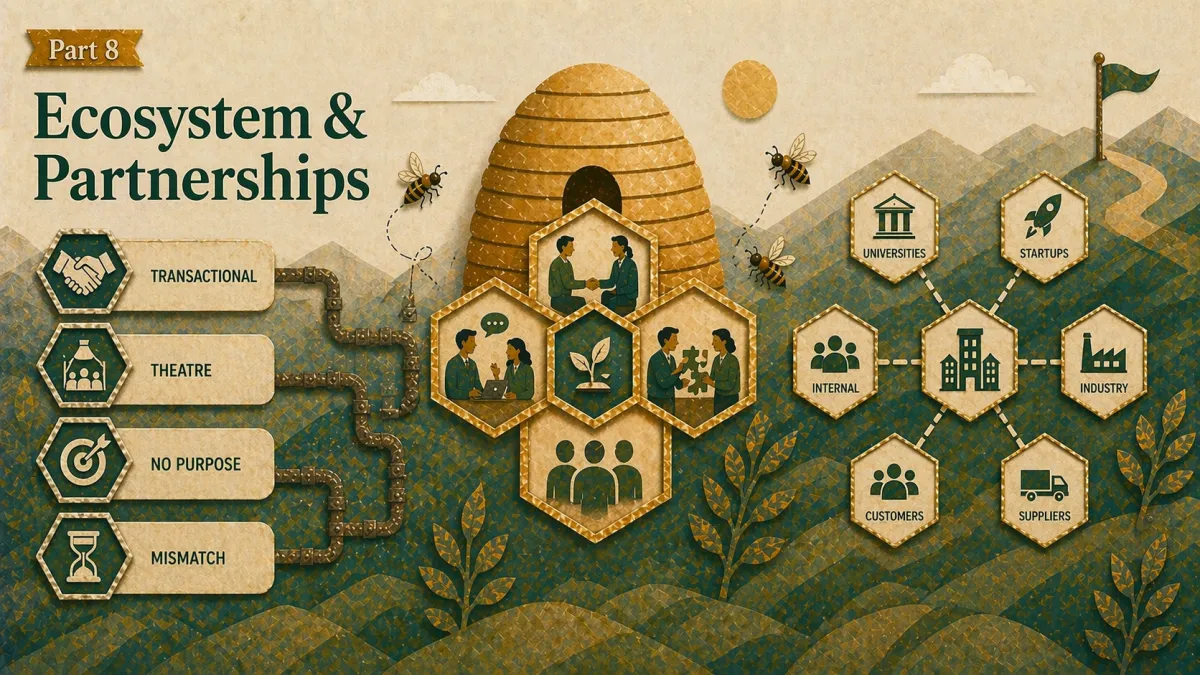
The first failure is the ecosystem as procurement exercise. Memoranda of understanding are signed with universities, startups, and industry bodies. The relationships are transactional, episodic, and often ceremonial. Nobody inside the organisation has a working relationship with anyone in the partner organisation. When something is actually needed, it is contracted from scratch.
The second is innovation theatre by partnership. The organisation holds events with startups, sponsors accelerators, runs hackathons. These produce publicity. They rarely produce capability or commercially adopted work. Leadership loses interest after a few cycles, correctly.
The third is ecosystem as an end in itself. The organisation invests in building an ecosystem but it is not clear what the ecosystem is for. A pipeline of acquisitions? A source of talent? A way to scan technologies? Without clarity on purpose, the ecosystem generates activity without outcomes.
The fourth, and this one costs real money, is the corporate-startup mismatch. The large organisation tries to partner with startups using its own procurement, legal, and timeline norms. The startup burns cash waiting for a decision, or walks away. The organisation concludes startups are difficult. The startups conclude corporates cannot move. Both are right. The fix is a specific, differently governed route by which the organisation can engage at startup speed.
But here is the one most organisations miss entirely. Your own business units, functions, geographies, and subsidiaries are often the richest innovation ecosystem you have, and also the most neglected. Cross-unit learning, talent movement, and co-innovation are frequently blocked by internal politics and incentive misalignment. An organisation that cannot leverage its own internal ecosystem should think carefully before pursuing grand external ambitions.
What to do this week
First, ask what your ecosystem strategy is in one paragraph. If you cannot articulate it, you do not have one.
Second, ask which of your current partnerships produced meaningful innovation outcomes in the last twelve months, and which produced only optics. Prune accordingly.
Third, look internally. How well does cross-unit collaboration actually work? Can teams in different business units access each other's learning, talent, and customer insight? If the answer is no, that is your highest-leverage ecosystem investment, and it costs nothing to start.
The ecosystem you actually have is the one that shows up when you need it. Build for that.
This concludes the eight-part Embedding Innovation series. The pillars are not a checklist. They are a system. Their real power is in how they interact. If you want to know where to start, the honest answer depends on which pillar is weakest. In most organisations, that is either Pillar 1 (leadership commitment is not real), Pillar 4 (capability was trained but never built), or Pillar 6 (culture quietly undoes everything). Start there.
If you want a structured diagnostic across all eight, that is what Phase 0 of the Honeybee Programme is designed to produce: a scored picture of your organisation against each pillar, a portfolio view of what you are actually working on, and a clear recommendation for where to start.
You can find out more here: Corporate trainings in Behaviour design
Or why not book a call and we can answer any questions: Book a call