
70% of Transformation Projects Still Fail. Open Innovation Has the Same Problem. And the Same Fix.
70% of Transformation Projects Still Fail. Open Innovation Has the Same Problem. And the Same Fix.
You already know the stat. Seven out of ten transformation projects fail. It has been roughly that number for over two decades. McKinsey said it. Kotter said it. Everyone nods gravely in meetings about it. And then most organisations go ahead and run the exact same playbook anyway.
Here is what is less discussed. Open innovation programmes fail at strikingly similar rates. Companies launch them with fanfare, build platforms, send all-staff emails, and then watch participation flatline within months. The post-mortems blame culture, or timing, or leadership commitment.
They are almost always wrong about the root cause.
It is a behaviour problem. It was always a behaviour problem.
Transformation does not fail because the strategy is bad. Open innovation does not fail because the technology is wrong. They fail because they require people to change what they do, and people are spectacularly resistant to that.
This is not a character flaw. It is wiring.
Status quo bias means we default to whatever we are already doing, even when the alternative is clearly better. Loss aversion means the fear of losing what we have outweighs the appeal of gaining something new. Think about how it feels to be asked to share your hard-won expertise with a crowd of strangers through a portal you did not ask for. That is not collaboration. That feels like giving away your competitive advantage.
And then there is territorial protection. The quiet, rational calculation that says: if everyone can contribute ideas, what happens to the people who were previously paid to be the idea people?
These are not objections you can PowerPoint away.
The playbook is broken
Most transformation and open innovation programmes follow the same logic. Design the strategy. Build the system. Cascade the message. Assume people will come.
This is the "Field of Dreams" model of organisational change. Build it and they will come. It assumes people behave rationally. That good communication equals behaviour change. That if you explain the vision clearly enough, people will get on board.
They will not. Or more precisely, they will say they are on board. They will attend the workshops. They will nod. And then they will go back to their desks and do exactly what they were doing before.
The gap between what organisations say will happen and what actually happens is where transformation goes to die. Communication is not the fix. More communication is definitely not the fix.
Behavioural design is the fix.
Three principles that actually work
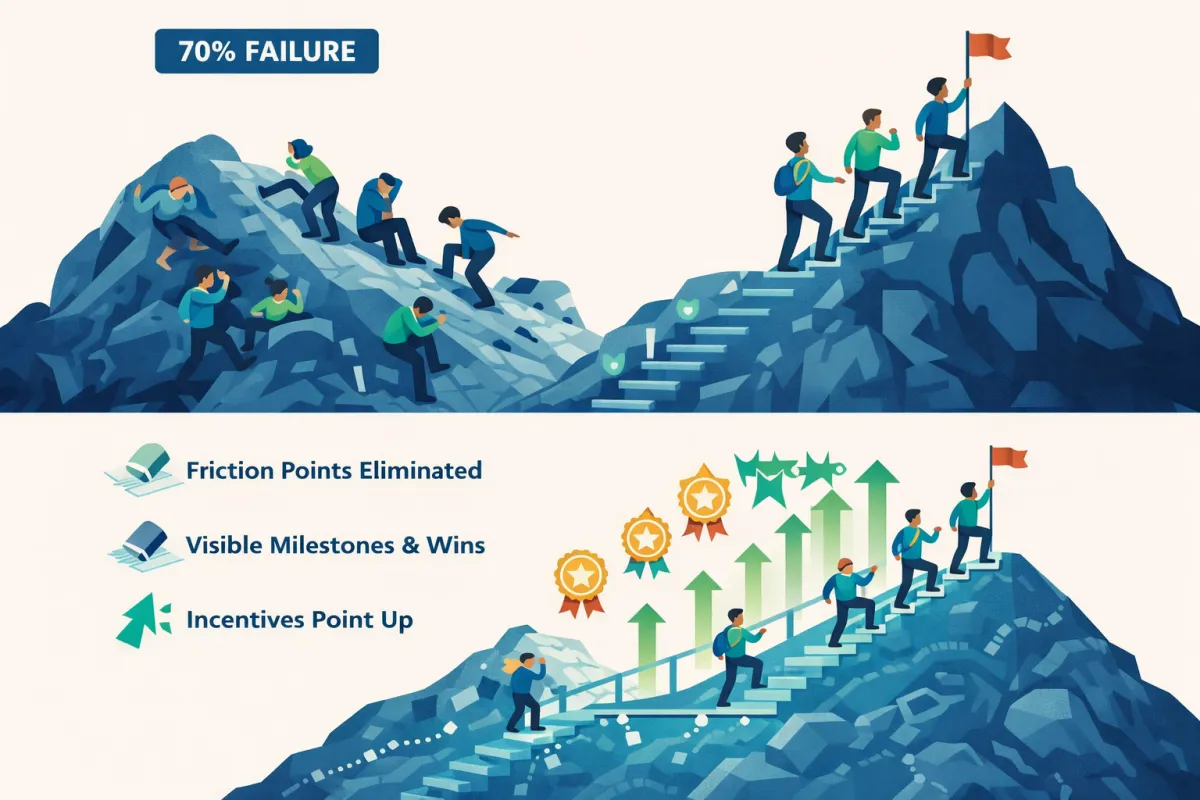
1. Reduce friction to the point of absurdity.
Every form field, approval layer, and ambiguous instruction is a reason to quit. People do not abandon your programme because they reject the vision. They abandon it because you made it annoying. If submitting an idea takes twelve clicks and a manager sign-off, you do not have an innovation platform. You have a filter that selects for stubbornness. Cut the steps. Then cut them again.
2. Design for small, visible wins early and often.
Social proof is the most powerful driver of behaviour change. Not emails from the CEO. Not town halls. Seeing someone like you succeed at the thing you are being asked to do. That is what moves people. Find one quick, tangible outcome in the first thirty days and make sure everyone hears about it. Not as propaganda. As evidence.
3. Rewire the invisible incentives.
This is the big one. Look at what your organisation actually rewards versus what it officially encourages. If you are asking people to collaborate across boundaries but promoting them based on individual output, you have a structural contradiction. People are not ignoring your programme. They are responding perfectly rationally to the incentive system you built. Fix the system, not the people.
Three things to do before you launch anything
First, audit your programme for friction. Map every step a participant has to take and eliminate at least half. Not after launch. Before.
Second, identify one deliverable that can show tangible value within thirty days. Then publicise it relentlessly. Make the win impossible to miss.
Third, review your existing incentive structures and find at least one place where what is rewarded contradicts what you are asking people to do. Fix that structural misalignment before kickoff. Not after the first disappointing quarterly review.
None of this is complicated. But it does require admitting that the problem is not out there in the culture or the mindset. It is in the design. Your design.
The organisations that crack transformation and open innovation will not be the ones with the best strategies or the slickest platforms. They will be the ones that took human behaviour seriously from day one.
"Stop announcing change. Start designing for it."