
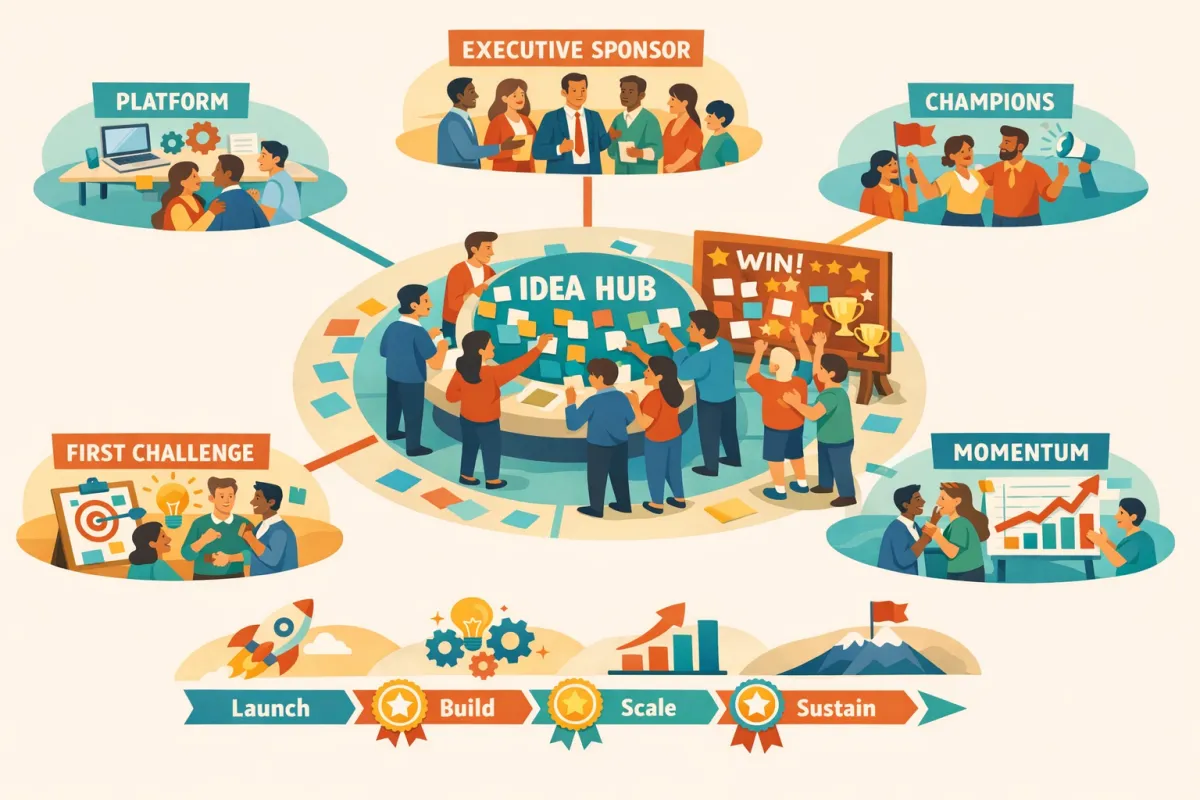
How to Start Your Own Open Innovation Hub (Without It Dying Quietly in Six Months)
How to Start Your Own Open Innovation Hub (Without It Dying Quietly in Six Months)
Most companies say they want innovation. Fewer actually build the conditions for it. And fewer still make it easy for the people closest to the problems to contribute ideas that get heard, evaluated, and acted on.
That is the gap an open innovation hub closes.
Not a suggestion box. Not a brainstorm away day. A structured, visible system where ideas flow in, get discussed, and move forward. Or get a clear "no" with reasons. Both outcomes are fine. Silence is the killer.
Here is how to build one that actually works.
Start With a Specific "Why"
"We want to be more innovative" is not a reason. It is a screensaver slogan.
You need something concrete. Something like: "We want to generate 50 process improvement ideas per quarter from frontline staff" or "We want to reduce customer complaint resolution time by sourcing fixes from the teams who handle them."
Your "why" shapes everything. It determines which platform you choose, who your stakeholders are, what success looks like in month one versus month six, and whether anyone beyond the innovation team cares.
Get this wrong and you will build something technically impressive that nobody uses. Get it right and you have a North Star that keeps the whole effort honest.
Choose the Right Tech Without Overthinking It
You need four things from your platform: idea capture, collaboration, evaluation, and tracking. That is it. If it does those four things well and people actually enjoy using it, you have a winner.
The trap is feature lists. Companies spend months comparing platforms on capabilities they will never use, then pick the one with the most impressive demo rather than the most usable interface.
Usability beats features every time. If your frontline staff find the tool confusing, they will not use it. Full stop.
Shortlist three platforms. Run a two-week pilot with real users. Choose based on their feedback, not on a procurement spreadsheet. The people submitting ideas are your customers here. Treat them like it.
Secure Visible Executive Sponsorship
This is where most innovation programmes quietly fail. They have approval but not advocacy.
You need a senior leader who does not just sign off the budget but actually shows up. Someone who submits their own ideas. Comments on other people's. Mentions the hub in town halls and leadership updates.
Why? Because when a director or VP visibly participates, it sends a signal that ripples through the organisation. Innovation is not a side project. It is not optional. It is how we work now.
Without that signal, people will treat your hub like another corporate initiative that will fade in a quarter.
Build Cross-Functional Buy-In Before You Launch
Do not announce the hub and hope people come. That is a launch strategy built on optimism, and optimism is not a strategy.
Before you go live, identify champions in different departments. Operations, customer service, finance, product. People who are naturally curious, well-connected, and a bit frustrated with how slowly things change. You know exactly who they are.
Give them early access. Ask for their input on the first challenge. Let them shape it.
When the hub launches, it should feel like an invitation from peers, not a mandate from above. People engage with things they helped build. That is not a theory. It is how humans work. Psychologists call it the IKEA effect. You value what you had a hand in creating.
Launch in Phases, Not a Big Bang
The instinct is to go big. Company-wide launch. All-hands email. Banners on the intranet.
Resist it.
Start with one focused challenge. Something specific, achievable, and relevant to a real business problem. Run it for four to six weeks. Celebrate the winners publicly. Show what happened to their ideas.
Then expand. Run a second challenge, slightly broader. Then a third. Each one builds confidence that this is real, that ideas lead somewhere, that participation matters.
Momentum is a choice you make deliberately. It does not happen by accident.
Three Things to Do This Week
One. Shortlist three innovation platforms, set up a two-week pilot with a small group, and choose based on user feedback. Not feature lists.
Two. Schedule a 30-minute pitch with the most innovation-friendly senior leader you know. Bring your "why", a rough cost estimate, and two examples of peers or competitors already doing this.
Three. Plan your first three challenge campaigns before launch day. Each one broader in scope than the last. Map the momentum before you need it.
You do not need permission to start thinking about this. You need a plan, a platform, and a sponsor. The rest is iteration.
"Build the system, trust the crowd, and never let a good idea die in an inbox."