
Innovation Governance Without Bureaucracy: Just Enough Structure
Innovation Governance Without Bureaucracy: Just Enough Structure
You need governance. You don't need committees.
Most organisations get this backwards. They build innovation governance by creating approval layers, steering committees, and decision frameworks. Then they wonder why nothing moves. A brilliant idea gets stuck waiting for the quarterly governance review. A team wants to run an experiment but needs three sign-offs first. The governance system becomes the thing that kills innovation instead of protecting it.
The best innovation governance I've seen doesn't look like governance at all. It looks invisible. It's just enough structure to keep chaos out without getting in the way of movement.
Why Traditional Governance Fails Innovation
Traditional governance exists to manage risk and ensure compliance. That makes sense for operations. You want to know that every process is documented, every decision is auditable, every risk is controlled. That's how you run a stable system.
Innovation is not a stable system. Innovation is discovering what works by trying things that might not. The moment you apply traditional governance thinking to it, you've killed the thing you're trying to protect.
Here's what happens: you create an innovation governance framework. It has stages. Stage gate reviews. You need approval to move from stage one to stage two. Suddenly, every team is writing 20-page business cases instead of running five small experiments. The friction is so high that people stop submitting ideas. They go back to doing their jobs the traditional way.
The governance system worked perfectly. It kept people from doing anything risky. It also kept them from doing anything new.
The Real Purpose of Governance
Good innovation governance isn't about preventing bad ideas. It's about three things: clarity, fairness, and speed.
Clarity means everyone knows the rules. You know what kind of ideas are welcome. You know who decides. You know how long decisions take. You know what happens if your idea gets rejected.
Fairness means the same standards apply to everyone. Your idea doesn't get blocked because of politics or because someone important doesn't like it. It gets evaluated on consistent criteria.
Speed means decisions happen fast. Not instantly. But fast enough that the decision doesn't become the bottleneck.
Traditional governance often gets the opposite of all three. Everyone's confused about the rules. The standards are different depending on who's asking. And decisions take months.
Three Principles for Governance That Works
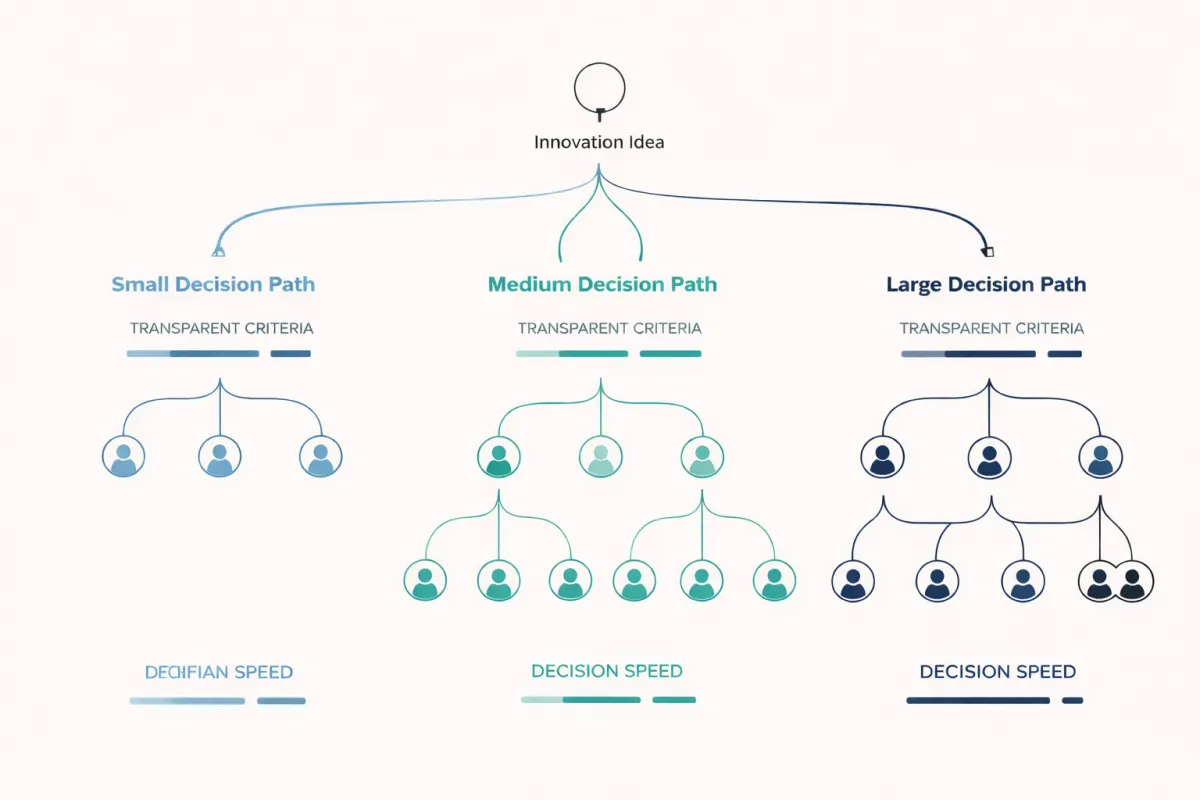
1. Distributed decision-making with clear escalation.
Don't create a central committee that approves everything. Create decision rights where they belong: with the people actually running the work.
A team wants to run a small experiment. They don't need approval. They just need to tell someone it's happening. A team wants to invest £50k in something new. Maybe they need a quick check-in with their manager. A team wants to build something that could reshape the organisation. Now you escalate to a governance conversation.
The key is clarity about where the line is. Everyone knows: experiments under £10k, go ahead. Between £10k and £100k, check in with your manager. Above £100k, governance review. Done.
This moves decision-making to the edge of the organisation where people actually understand the context.
2. Transparent criteria, not opaque judgment.
When people submit ideas, they should know exactly how they're being evaluated. Not "we'll know it when we see it." Actual criteria.
Maybe it's: Does it address a real customer problem? Can we build a prototype in three months? Does it fit our strategic direction? Does it use existing capabilities or does it require new skills we don't have?
When people know the criteria up front, they self-select. Good ideas get submitted. Ideas that don't fit don't waste everyone's time. And when something does get rejected, people understand why. It's not political. It's just the criteria.
3. Experiment protocols instead of approval gates.
Instead of asking "is this idea good enough to do?", ask "what would we need to learn to know if this idea is worth doing?"
This shifts from binary approval (yes/no) to learning (what's the smallest, fastest way to test if this works?).
A team has an idea. Instead of writing a business case, they design a four-week experiment. They'll test with 50 customers. They'll measure three things. If those three things move in the right direction, they'll get investment to scale. If not, they'll kill it.
Approval becomes fast because you're not asking for certainty. You're asking: is this a reasonable test? Is there a clear decision rule? Can we run it in four weeks? Yes? Go.
What You Don't Do
You don't create an innovation committee that reviews every idea. You don't require approval before experimentation. You don't design governance at the centre and push it out to teams. You don't make governance about protecting the status quo.
You do create clear rules. You do make decisions fast. You do push decision-making to the edge. You do design governance to enable speed, not prevent risk.
One Thing to Change This Week
Map your current innovation governance. How does an idea actually move from "someone has a thought" to "we're running this"? How many approvals? How long does it take? Who decides?
Now ask: what's the one friction point that's killing more ideas than anything else?
That's your target. Not to remove all governance. Just to remove that one thing that's in the way.
Because the best governance is the kind people don't think about. It's just there, quietly, making sure chaos doesn't break the system. Everything else moves.
---
Innovation governance should enable speed, not prevent risk. Distribute decisions, make criteria clear, and design experiments instead of approvals.