
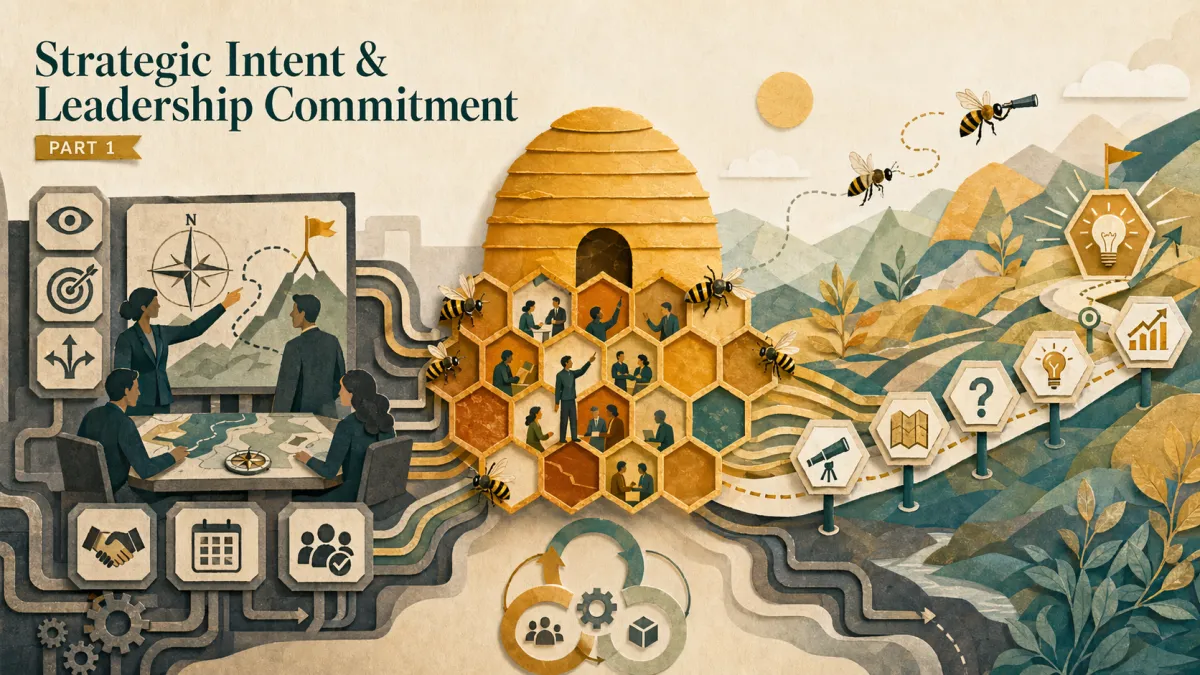
Why Your Innovation Strategy Exists on a Slide and Nowhere Else — Embedding Innovation Series: Part 1
This is the first in an eight-part series on what it actually takes to embed and scale innovation inside a large organisation. Each post covers one of eight pillars drawn from the Honeybee Programme, a transformation architecture built on a simple operating philosophy: people first, then process, then products, running as a circle, not a line. And a metaphor that earns its place: the Hive is your organisation, the Honeycomb is where work gets done, the Bees are your people, and the Scouts are the small, well-supported minority whose job is to find tomorrow's opportunity.
Part 1 is about strategic intent and leadership commitment. It is the first pillar because without it, everything else is theatre.
Here is the test. Ask ten of your senior leaders, separately, what your innovation strategy is. If you get ten different answers, you do not have a strategy. You have a slide deck.
Most large organisations have published their innovation priorities. Usually four or five themes, each with a one-word name and an icon. And then nothing changes. The CEO's calendar does not reflect the priorities. The quarterly review does not either. Capital allocation stays the same. Within six months, every middle manager in the building has quietly concluded that the real strategy is whatever keeps finance happy.
This is not cynicism. It is rationality. People watch what leadership does, not what leadership says. And leadership, in most organisations, delegates innovation rather than committing to it. They name a head of innovation, give them a budget, and do not come back until the annual review. That is not commitment. That is assignment. The organisation can tell the difference within weeks.
The second trap is intent without scope. Leadership says they want innovation but means everything: new products, new services, new business models, new geographies, new technologies. Without scope, the innovation function either tries to do everything badly or picks its own scope and gets criticised for the wrong choice. The scoping conversation, where do we innovate and where do we not, is one of the most valuable a leadership team can have and one of the most avoided.
The third, and most subtle, trap hits long-established organisations hardest. The leadership says "we want to be innovative" but the company's identity is built on operational reliability, engineering excellence, or service consistency. Intent and identity are in conflict. Identity always wins. The fix is not to override identity. It is to reframe: operational excellence requires continuous innovation in how we operate. Service consistency requires continuous innovation in how we listen. Engineering excellence requires continuous innovation in the methods of engineering itself.
What to do this week
First, write the answer to two questions in your own words, without a slide: why are we doing innovation, and what does success look like in a way we can tell from failure? If you cannot answer both clearly, that is your starting point.
Second, look at your calendar for t he last quarter. How much substantive time did you spend on innovation work? Not mentions. Not five-minute check-ins. Actual working time. If the answer is less than ten percent, the organisation already knows where your real priorities are.
Third, name what is out of scope. If your innovation function does not know what it is not supposed to do, it will either do everything or do nothing well.
A clear intent, visibly and personally backed by leadership, is worth more than a hundred frameworks.
Next in the series: Part 2, where intent either becomes executable or quietly dies, in the structure and accounting that surrounds innovation work.
You can find out more here: Corporate trainings in Behaviour design
Or why not book a call and we can answer any questions: Book a call