
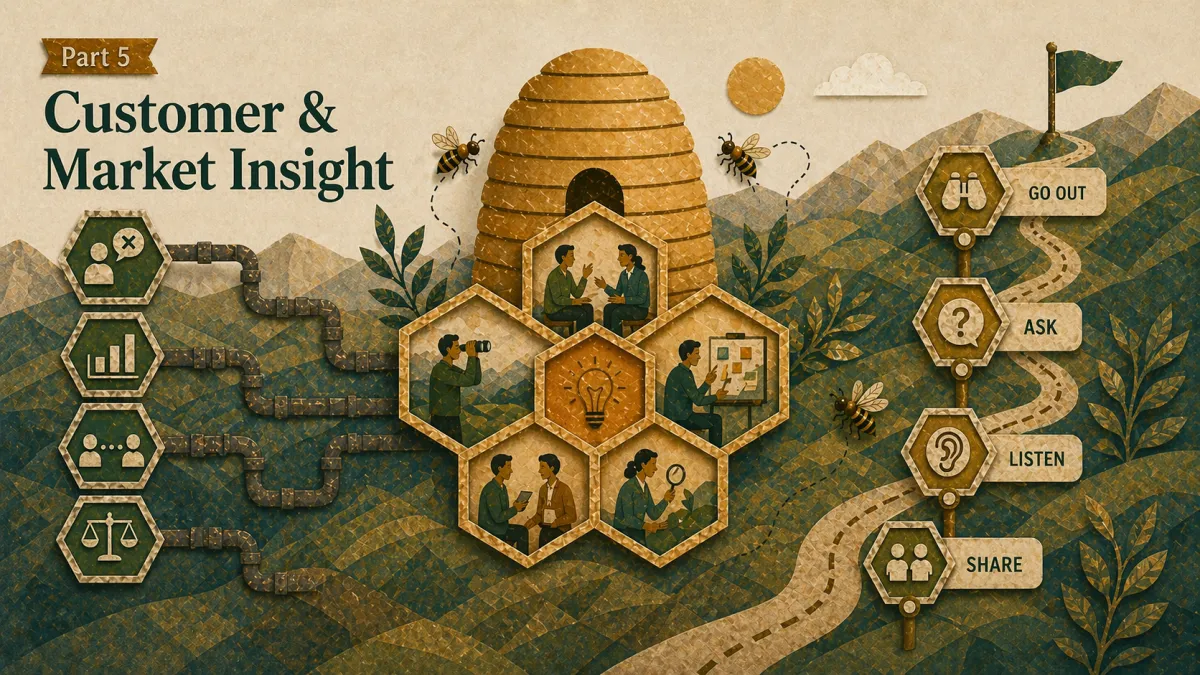
Your Product Team Has Not Spoken to a Customer in Months. That Is Your Innovation Problem. — Embedding Innovation Series: Part 5
This is the fifth in an eight-part series on embedding innovation in large organisations, from the Honeybee Programme. People first, then process, then products, as a circle. The Hive is your organisation, the Honeycomb is where work happens, the Bees are your people, and the Scouts find tomorrow's opportunity.
Part 5 is about customer and market insight. This is the pillar that determines whether everything else is pointed at anything real.
Every framework worth its name, design thinking, lean startup, jobs-to-be-done, service design, behavioural science, is built on the same premise: you cannot innovate usefully from inside the building. You have to go out. Structurally. Repeatedly. With the right questions. Insight is not a study commissioned once a year. It is a muscle the organisation exercises continuously.
The first failure is substituting internal opinion for customer evidence. A senior leader's belief about what customers want, often formed years ago in a different role, becomes the de facto product strategy. Teams do not push back because it is career-limiting. The product gets built. It does not land. The failure is attributed to execution.
The second failure is market research in place of customer discovery. A large quantitative survey is commissioned. It produces percentages. The percentages are reassuring. They do not reveal anything the team did not already know. Quantitative research is useful for confirming what you have learned qualitatively. It is not a substitute for the qualitative work.
The third failure is research done by proxy. Teams talk to the sales team, who talk to the customer. Every layer between the builder and the customer filters the signal and distorts it. By the time it reaches the builder, it is opinion about customers, not customer evidence.
The fourth is confusing stated preference with actual behaviour. People tell you what they think they want. Their behaviour often reveals something different, sometimes opposite. This is the say-do gap. Systems built on stated preference fail against systems built on observed behaviour. Listening is not enough. You have to watch.
The fifth, specific to B2B, is insight held by the salesforce as personal asset. Every good salesperson has invaluable, specific, current customer insight in their head. Very little of it is captured, shared, or fed into innovation. The organisation is insight-rich and insight-poor at the same time.
What to do this week
First, ask when the person leading your most important innovation project last personally spoke to a live customer. This week? This quarter? Ever?
Second, ask where your customer insight lives. One place? Multiple places? Mostly in people's heads? If there is nowhere a new team can start by reading what was learned last quarter, you are paying full price for every insight.
Third, ask how often findings from customer research actually change the work. If the answer is rarely, either the research is bad or the organisation is not letting insight shape what it builds.
You cannot innovate your way to a product customers will love if no one in the building has spoken to one.
Next in the series: Part 6, on why culture is the water your people swim in, and why designing against reversion is the difference between lasting change and expensive theatre.
You can find out more here: Corporate trainings in Behaviour design
Or why not book a call and we can answer any questions: Book a call